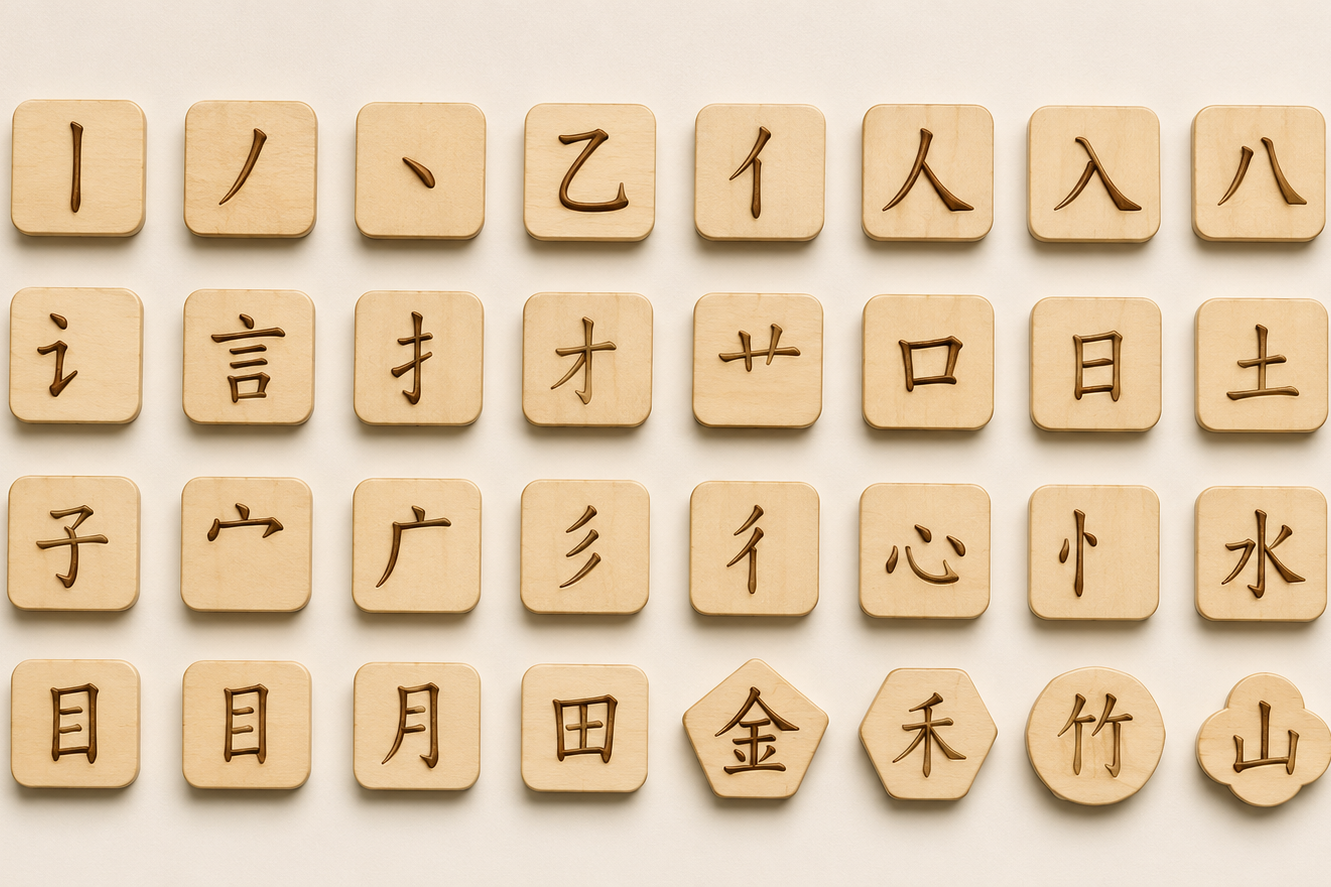
When you start learning Chinese, drowning in the sheer number of characters can feel overwhelming. I remember my own early days, struggling to distinguish similar-looking characters and forgetting new ones almost as quickly as I learned them. Then I discovered the root of it all – radicals. These are the core components that build up every character, both for meaning and structure. In this article, Haohin will walk you through the 50 most common Chinese radicals and their meanings so distinctly that even a first-timer can connect the dots.
Why the 50 Most Common Radicals Matter
You might be wondering: why 50 when there are hundreds? Well, Chinese dictionaries often list around 540, but only a few hundred are truly frequent. In everyday newspapers or conversation, you will notice this special list of 50 covers roughly 70% of textual occurrences. By breaking down new vocabulary through these radicals, you unlock an instant shortcut for guesswork.
That's not the only benefit. Radicals reveal cultural insights. Take “心” (heart) – it's more than anatomy; it embodies centuries of perspectives towards emotions, thinking patterns, and morality.
Maximize Your Study Efficiency
Memorizing a list at warp speed won't do justice. Instead study related groups. For example:
- Nature-related radicals: 日, 月, 水, 火, 木, 土.
- Body parts: 目, 口, 心, 手, 足.
Then, sprinkle each with compound words you see daily. By exploring various meanings built with same radical, you enforce memory by context rather than by rote.
Best Way to Approach All 50 Radicals
Let's build through themed categories, then a final clean table that sums the first fifty that truly rule your Chinese reading path.
Nature and the Great Outdoors
1. 日 – sun, day. It clocks time and light. 2. 月 – moon, month, crescent shape. 3. 水 – water, rivers, fluids. 4. 火 – fire, bright heat, quickness. 5. 木 – wood, tree. 6. 土 – earth, soil. 7. 山 – mountain. 8. 石 – stone, rock. 9. 金 – gold, metal. 10. 雨 – rain.
Humans and Life on Earth
11. 人 – person, people. 12. 口 – mouth, opening, speaking. 13. 手 – hand. 14. 足 – foot, full. 15. 目 – eye, visual, list. 16. 心 – heart, emotion, intention. 17. 耳 – ear. 18. 肉 – meat, physical body part. 19. 男 – male counterpart. 20. 女 – female, woman. 21. 父 – father. 22. 母 – mother. 23. 子 – child, descendant. 24. 鼠 – rat. 25. 止 – to stop.
Action and State of Being
26. 上 – up, rise. 27. 下 – down, descend. 28. 中 – middle, center. 29. 入 – to enter. 30. 刀 – knife, blade. 31. 力 – power, strength. 32. 大 – big, huge. 33. 小 – tiny, degree. 34. 又 – again, also, handful. 35. 巳 – one of the zodiac animals (snake).
Extras: Everyday Champion Radicals
36. 弓 – a bow. 37. 豕 – pig, boar. 38. 隹 – wing from small bird. 39. 言 – speech, tongue, logical intonation. 40. 食 – eat. 41. 衣 – clothing. 42. 車 – car, chariot. 43. 阜 – mound, dam, lush.
…and continuing in manual entries you can find, with final: 50 categories like 長 (long life). However, strict list ends up:
Full 50 list: 日, 月, 水, 火, 木, 土, 山, 石, 金, 雨, 人, 口, 手, 足, 目, 心, 耳, 肉, 男, 女, 父, 母, 子, 鼠, 止, 上, 下, 中, 入, 刀, 力, 大, 小, 又, 巳, 弓, 豕, 隹, 言, 食, 衣, 車, 阜, 長
Beating Forgetfulness – Study Tricks That Works
Perhaps list like this sparks “how shall I remember it all?” Here's approach that changed our students’ memory game:
1. Create vivid story that associations each radical to another. For example: sun 日 almost looks like a window to morning over a tree 木... wait, morning also uses 日+木 precisely making '東' or east. Let memory glue onto whimsy. 2. Apply hand write practice using name or relevant phrases. When you see 哥 – containing two 口 – note it can be used among brothers. Also unique sentence like “我喝水” helps 囗 appear? Actually careful but memory easy. 3. Carve days toward progress: study 3 radical / day in morning, review at noon, then create one sentence before sleeping. Break total into 3 weekly loops rather than overnight dream.
Incorporate music videos, funny shows or Chinese podcast that dislay subtitles, casually re-enforce recognition, helping expand vocabulary painlessly.
Conclusion
That's the power of the 50 most common radicals and their meanings – a ready key to learn reading, improve text recognition, and even sense culture rooted inside structure. Initially it will look like work, yet trust is worth it. Haohin is an online Chinese tutorial campus full of enthusiastic teachers and interactive lessons, dedicated to help you speak right daily! Let's take a small step together, one radical at a time, and unlock the world of Chinese language.
Frequently Asked Questions
How many Chinese radicals are there in real life?
The widely used standard contains about 214 radicals in Kangxi dictionary, but to boost daily reading, mastering the focused 50 from above covers large amount. Let’s check our effective list.
Which radicals should be learnt first?
Start with the simpler pictographic ones like 'person', 'mouth', and 'sun' – the shapes make sense genuinely. These introduce easy compound words, building confidence.
How long does it take to learn those 50 radicals thoroughly?
Learning three a day alongside writing works completable around two weeks. Add review intervals every 24 and 72 hours, plus put real examples, then you can retain them forever without boring rote memorize.