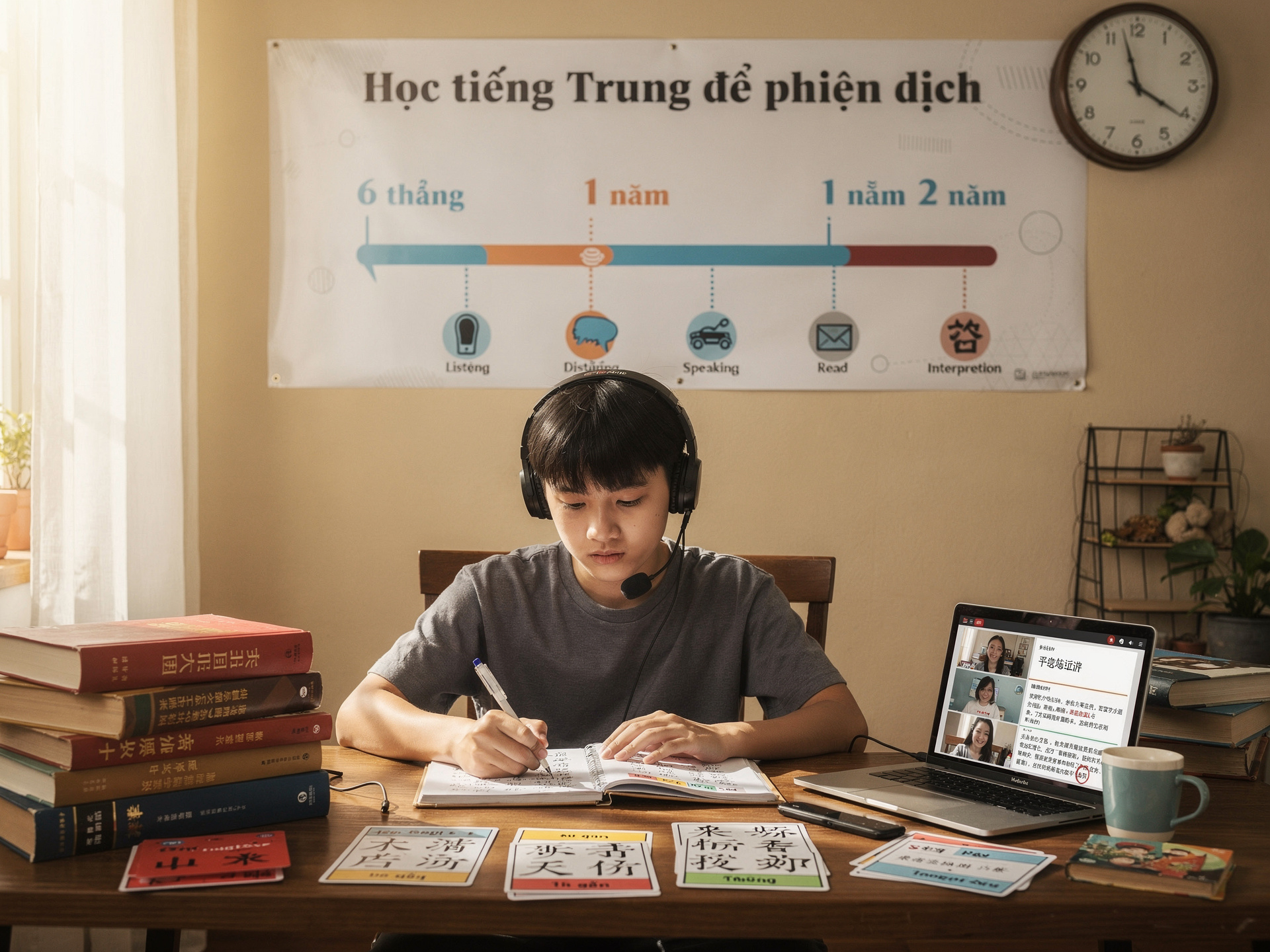
Figuring out how long does it take to learn Chinese for interpreting is one of the first questions every new learner asks. The honest answer is that there is no single number, because your timeline depends on where you start, how many hours you put in each week, and what kind of interpreting you are aiming for.
This article breaks the journey into stages, compares common routes, and points out where people often lose an extra year or two without realizing it.
What determines your timeline
Your starting point
If you already know some Chinese characters or studied Chinese at school, you save a fair amount of time. A complete beginner usually needs the first six to nine months just to get comfortable with tones, pronunciation, and around 800–1,000 common characters.
On the other hand, if you have lived or worked around Chinese speakers, your listening and speaking reflexes are already there, and you can move into interpreting practice much sooner. Learners in Vietnam can create this advantage by watching news, dramas, or talking with native speakers daily.
Weekly study hours
Study hours are the strongest variable. As a general rule, reaching HSK 4 (roughly 1,200 words, able to handle many familiar situations) takes about 600–800 effective study hours. HSK 5 adds another 400–600 hours.
At 10 hours a week, you could reach HSK 4 in around 18 months. At 20 hours a week of focused part-time study, that shrinks to 8–10 months. Full-time study of 5–6 hours a day is faster still, but only sustainable if you have strong discipline and good mental stamina.
The type of interpreting you want
This is the factor many people overlook. Business, travel, and simple trade interpreting need a vocabulary of roughly 3,000–4,000 words plus quick reflexes for short sentences. Conference interpreting, political negotiation, or medical work requires deep specialized vocabulary, strong memory, and clear delivery under real-time pressure. The gap between these two levels can be two to three years of practice.
Sample roadmaps by goal
Basic goal: simple conversation and business interpreting
For a complete beginner studying 10–15 hours a week, a typical route looks like this:
- Months 1–3: pinyin, tones, 300–500 characters, basic greetings.
- Months 4–9: grow to 1,000–1,500 words, practice slow dialogues, speak about familiar topics.
- Months 10–18: reach HSK 4, start translating short passages, get used to quick note-taking.
- Months 19–24: practice interpreting in simulated settings (shopping, ordering, reception), handle natural speech with intonation.
After about two years of serious study, you can confidently take simple interpreting jobs, provided you have practiced your reflexes enough. Many learners start picking up small jobs around month 16–18.
Advanced goal: professional interpreting
To work as a professional interpreter in companies, conferences, or legal settings, you need:
- A vocabulary of 8,000–10,000 words, including idioms and technical terms.
- Understanding of natural-speed Chinese, including regional accents (Cantonese, Taiwanese, Sichuanese, and others).
- Note-taking techniques and the ability to handle information gaps.
- At least 200–300 hours of real interpreting practice with feedback.
At 15–20 hours a week with a teacher correcting you, this goal usually takes three to four years. Full-time study with early internship opportunities can shorten it to about 2.5–3 years.
How to shorten the journey
Study actively, not passively
Many learners spend thousands of hours listening to music or watching shows but see little progress in interpretation. That is passive listening. A better method: take a 30–60 second dialogue, listen sentence by sentence, pause, and interpret immediately. Repeat until you can interpret without pausing. This takes 20 minutes but is worth more than two hours of passive listening.
Practice note-taking early
Note-taking keeps you from losing the thread in a 30–60 second stretch of speech. You can start when you reach HSK 3–4 by jotting down key ideas from short news clips, using your own symbols, arrows, and abbreviations. After three to six months of regular practice, your recall speed improves noticeably.
Build a practice environment
Join study groups, Chinese clubs, or find a partner to role-play situations. If you can, volunteer to interpret at small events to build experience. Even one or two hours of real practice helps you spot gaps much faster than studying alone. If you are self-studying, you might look into structured online Chinese courses that give you a roadmap and timely correction.
Track progress with numbers
Set weekly targets: learn 50 new words, interpret 10 dialogues, take notes on 3 news clips. Record your study hours and the words you actually remember. After each month, you will clearly see what is slow and adjust. Measurement helps you avoid the feeling of "studying forever with no progress."
Common misconceptions
Finishing HSK 6 means you can interpret
HSK 6 is a solid milestone for vocabulary and reading, but interpreting also needs speaking reflexes, note-taking technique, and the ability to handle pressure. Many HSK 6 holders still struggle with sight interpreting because they never trained this separate skill.
More hours always means faster progress
Quality beats quantity. Four tired, distracted hours can be less effective than 1.5 hours of deep focus. Break your study into shorter sessions, take short breaks, and prioritize activities that require you to produce language (speaking, writing, interpreting) rather than just absorb it.
Being good at Chinese is enough
Interpreting is its own skill. You also need strong Vietnamese, background knowledge in your field, and soft skills like staying calm and handling unclear audio. Do not skip building your Vietnamese and reading industry materials.
Final thoughts
How long does it take to learn Chinese for interpreting is not a fixed number. For beginners, about two years of serious study can be enough for simple interpreting; for professional work, plan on three to four years. The key is to study with clear goals, train your reflexes early, and measure progress regularly.
Frequently Asked Questions
How long until I can start interpreting?
At 10–15 hours a week, you can start simple conversational interpreting after about 18–24 months. Professional interpreting usually takes three to four years of study and practice with feedback.
Can I become an interpreter without natural language talent?
Yes. Interpreting is a trainable skill. Consistency, the right method, and regular reflex practice matter more than talent. Many people without a "gift" for languages become solid interpreters through systematic practice.
When should I start practicing interpreting?
You can begin translating short passages once you reach HSK 3–4. At that stage, focus on speaking reflexes and note-taking instead of waiting until you finish HSK 6.