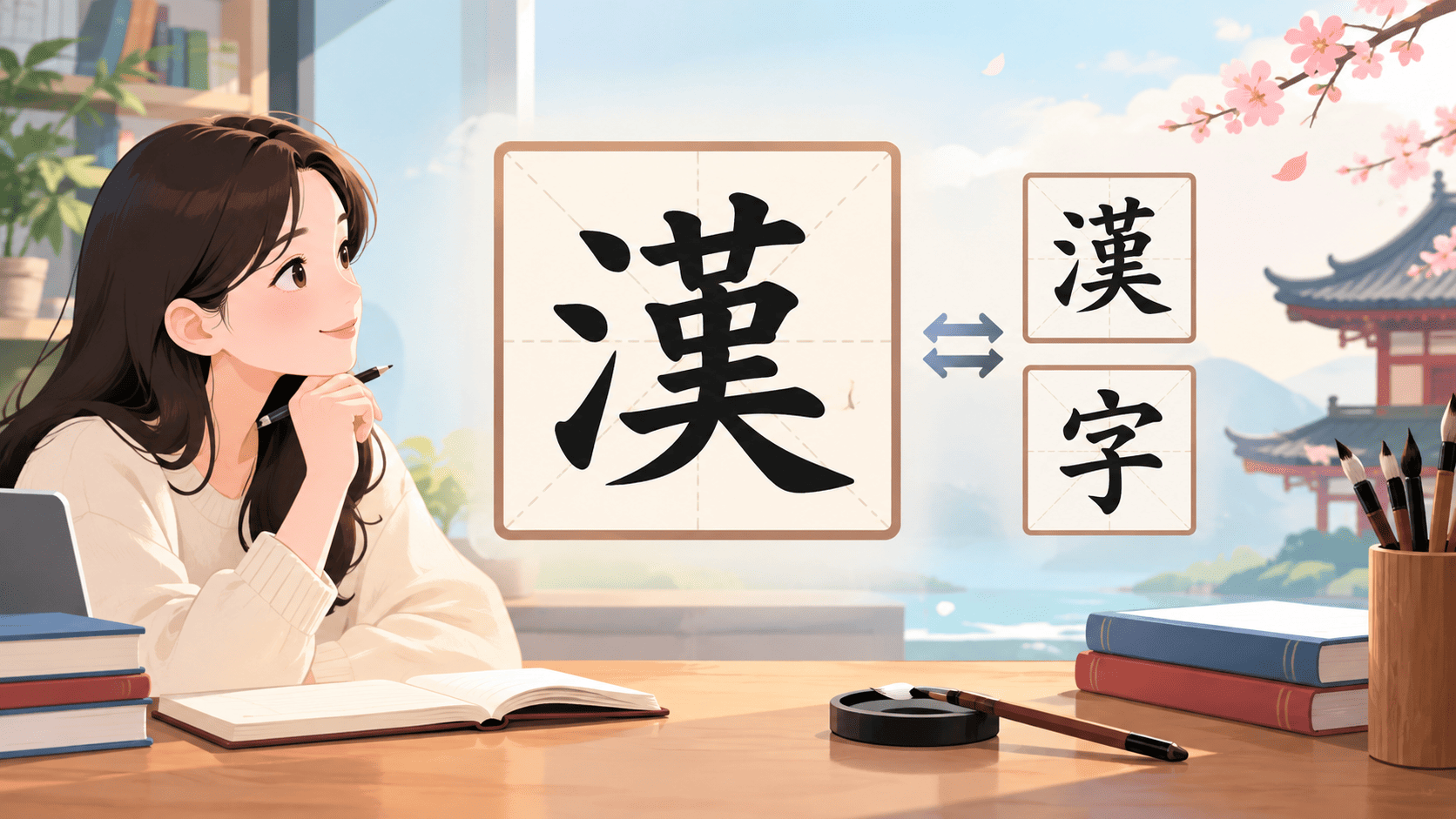
Have you ever seen a familiar Chinese character in Japanese and wondered: is kanji Chinese? This is a very common question, especially for those new to East Asian writing systems. The short answer is: kanji originated from Chinese characters, but they are not exactly Chinese. They have undergone a process of Japanization, changing in pronunciation, meaning, and usage. Let's analyze this further so you no longer confuse the two.
Origin of kanji and its connection to Chinese characters
How kanji was introduced to Japan
Around the 5th-6th century, the Japanese had no writing system of their own. They adopted Chinese characters from China through cultural exchanges, especially via Korea and Buddhist monks. Initially, the Japanese used Chinese characters for recording, but since Japanese grammar and syllables were different, they gradually created two kana scripts (hiragana and katakana) to represent native sounds. Kanji was retained to express meaning, creating the mixed writing system unique to Japanese.
Changes in form and meaning
Many kanji have changed compared to their original Chinese forms. For example, the character 学 (study) in Japanese has similar strokes to 學 in traditional Chinese, but is simpler. Or the character 電 (electricity) in Japanese still looks close to simplified Chinese, but the pronunciation is completely different. Some kanji even changed meaning, such as 手紙 (tegami) in Japanese means "letter", but in Chinese 手纸 means "toilet paper". These differences make learning kanji both fascinating and challenging.
Is kanji Chinese? Clear distinctions
Historically and linguistically
In terms of origin, kanji borrowed from Chinese characters, so they share a common ancestor. However, Chinese and Japanese belong to completely different language families: Chinese is monosyllabic and tonal; Japanese is agglutinative and non-tonal. Therefore, kanji is used within Japanese grammar, with on-yomi (Sino-Japanese reading) and kun-yomi (native Japanese reading). This means kanji is no longer pure Chinese.
In practical use
When you learn Chinese, you encounter simplified (or traditional) characters with a single pronunciation (pinyin). In Japanese, a kanji can have multiple readings depending on context. For example, the character 日 can be read as "nichi" (in 日本 - Japan) or "hi" (in 日々 - every day). This distinction is crucial to avoid confusion when studying both languages. If you want to delve deeper into specialized vocabulary, you can refer to specialized Chinese courses for a structured path.
Why many people mistake kanji for Chinese
Visual similarity
About 60% of Japanese vocabulary originates from Chinese, but not all retain the same meaning. Beginners often see 安全 in both Japanese and Chinese meaning "safe", so they easily think they are completely identical. However, many other words differ, such as 勉強 in Japanese means "study", while in Chinese it means "reluctantly". This superficial similarity is the main cause of confusion.
Cultural and media influence
Japanese films, comics, and media have entered many countries with Chinese characters appearing densely. People who are already familiar with Chinese characters through their native language may associate kanji immediately with Chinese. In reality, kanji is just one part of the Japanese writing system, alongside hiragana and katakana. To understand correctly, you need to look at how Japanese people use them daily.
Points to note when learning kanji and Chinese
Advantages for learners with Chinese character background
Learners who know Chinese characters have a great advantage. You can easily guess the meaning of many kanji and Chinese characters. For example, 学校 (school) in Japanese and 学校 in Chinese both mean "school". However, don't be overconfident, as there are still "trap" words with different meanings.
Effective study methods to avoid confusion
When learning kanji, learn both on and kun readings, and place them in specific sentences. For Chinese, you need to master pinyin and tones. Don't translate word by word; learn in phrases. If you want to learn Chinese systematically, seek reputable resources and practice listening and speaking regularly. Comparing kanji and Chinese characters also helps you remember more deeply.
Conclusion
Kanji originated from Chinese characters, but has been adapted by Japan to fit its language and culture. Therefore, kanji is no longer Chinese in the literal sense, but a part of Japanese. Understanding this will help you study more effectively and avoid confusion between the two languages. If you are looking for a structured Chinese learning path, start with foundational knowledge and practice consistently every day.
Frequently Asked Questions
Are kanji and Chinese characters exactly the same?
No. Kanji borrowed from Chinese characters but has changed in form, pronunciation, and sometimes meaning. Many kanji have been simplified or altered to fit Japanese.
Can Chinese speakers read kanji?
They can guess the meaning of many words, but cannot read them accurately because Japanese pronunciation is completely different. Some words have entirely different meanings.
Should I learn kanji before learning Chinese?
Not necessarily. If you want to learn Chinese, focus on simplified characters and pinyin first. Kanji is useful if you study Japanese, but don't confuse the two systems.