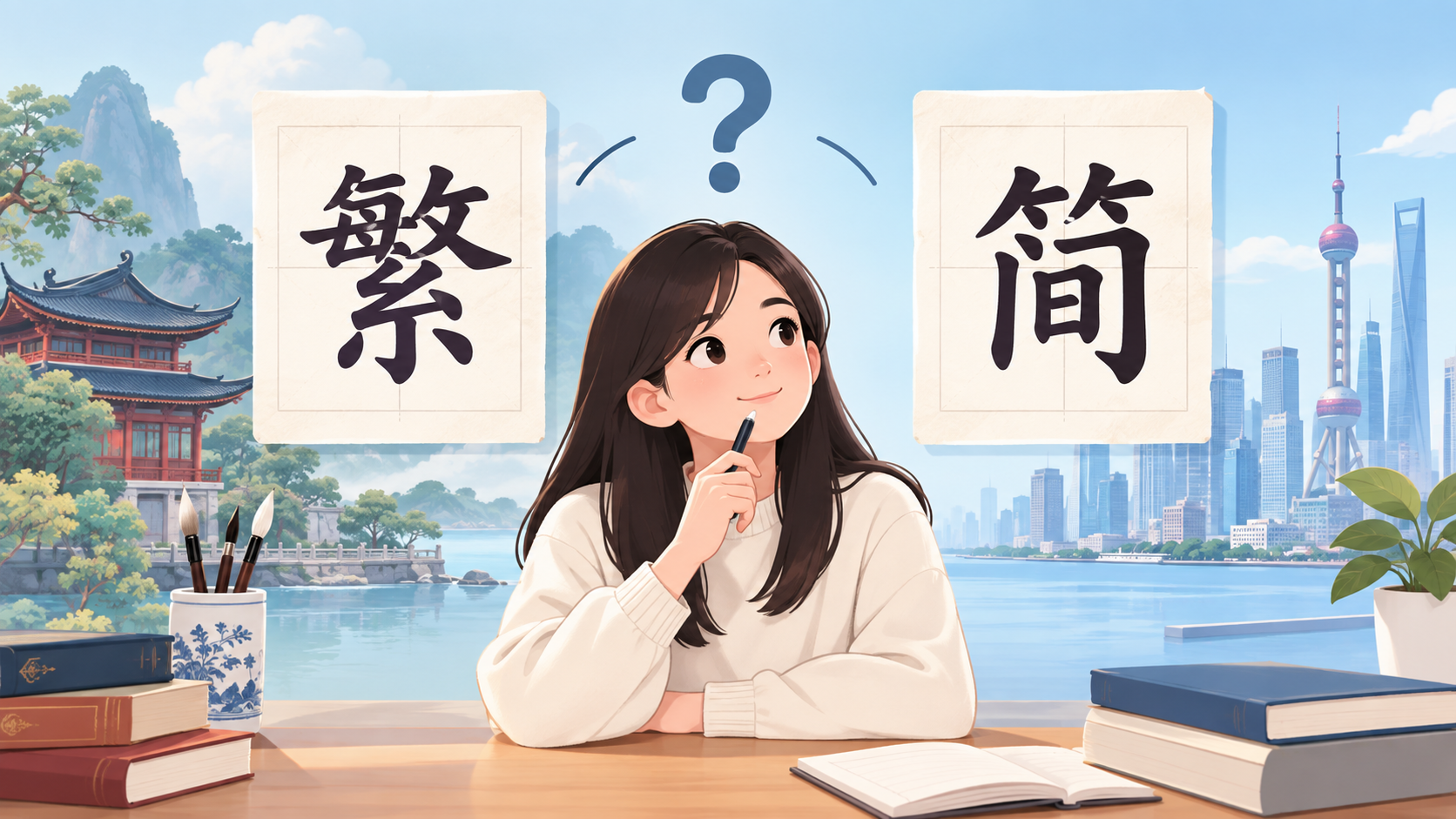
Is Standard Chinese Traditional or Simplified characters? That question pops up the moment a beginner sees two very different looking versions of the same word. You download a vocabulary app and get 汉字, but you switch on a Taiwanese drama or read news from Hong Kong and find 漢字. So which one is actually used in the Standard Chinese you are learning?
Which character set Standard Chinese uses
Standard Chinese, known as 普通话 (Putonghua) or Mandarin, is built on Simplified characters in mainland China. When you open an HSK textbook, watch CCTV news, or read a document from a mainland company, practically everything appears in Simplified form. A few quick examples:
- 学 instead of 學 for study
- 国 instead of 國 for country
- 车 instead of 車 for vehicle
- 语 instead of 語 for language
So the short answer to whether Standard Chinese uses Traditional or Simplified characters is that Simplified is the standard system. That said, the real picture is a bit richer, because Traditional characters are alive and well in several regions and contexts. This is why many learners imagine they are dealing with two separate languages, when in fact they are just two ways of writing the same Chinese script.
Where Traditional characters are still common
Traditional characters remain the norm in Taiwan, Hong Kong, Macau, and many overseas Chinese communities. In Taiwan, students learn Traditional script from day one, and textbooks, newspapers, and subtitles all use it. Hong Kong follows a similar path, though Cantonese dominates everyday speech there. So if you enjoy Taiwanese films, read novels published in Taipei, or work with partners in Hong Kong, Traditional characters will surround you constantly.
Here is a fun detail: the two systems are not sealed off from each other. A Simplified learner can often read a fair amount of Traditional text, especially once they recognize common radicals and patterns. On the other side, a Traditional reader can often guess Simplified forms after learning a handful of simplification rules.
Why two systems exist at all
Character simplification happened in stages, with the biggest push in the mid-20th century to reduce stroke counts and make reading, writing, and printing easier. Simplified characters were not invented from scratch; many came from handwriting forms, cursive styles, and variant characters that had existed for centuries, later standardized through official lists. Traditional characters keep the older, fuller forms, which means more strokes and, for beginners, sometimes more to memorize.
This difference does not change grammar, pronunciation, or meaning. Whether you write 我学汉语 or 我學漢語, a listener hears the same sentence. That is also why you should not panic if you mix up both systems while learning, as long as your meaning and context are clear.
Should you learn Simplified or Traditional first
The answer depends on your goal.
If you are studying for HSK, working with mainland Chinese companies, planning to study in Beijing or Shanghai, or simply want to follow domestic shows and news, Simplified is the sensible starting point. The user base is much larger and learning materials are everywhere. Open a flashcard app and Simplified is usually the default.
If you are drawn to Taiwanese culture, want to read classical poetry and canonical texts, or work closely with partners in Hong Kong, Traditional will serve you better. Some learners start with Traditional because they grew up around it, then move toward Simplified when exams or work require it.
You do not need to tackle both at once. Pick one system, build a solid foundation, then add the other. With steady practice, many learners only need a few weeks to get comfortable with the second system once the first is firm.
Switching between them is not purely mechanical, though. Over two thousand Simplified characters differ noticeably from their Traditional forms, grouped by a few recurring patterns: simpler radicals, replacing complex components with simple symbols, and merging several Traditional characters into one Simplified character. Some Traditional characters look different but share a single Simplified form, so context matters when reading Traditional text. As you practice, you can explore materials on this site that include subject-specific Chinese to sharpen the distinction between the two systems, especially when you need to read professional documents.
Quick ways to tell them apart
A few signals help you guess which system you are reading:
- Dense, complex shapes: usually Traditional.
- Seeing forms like 這, 們, 開, 關, 學, 體: Traditional.
- Seeing forms like 这, 们, 开, 关, 学, 体: Simplified.
- Simple, stripped-down characters like 汉, 语, 电, 话, 车, 东 are almost always Simplified.
Bilingual books make comparison easy and help you remember faster. Another useful habit is jotting new words as a Simplified–Traditional pair from the start, so you learn meaning and shape together.
Common misunderstandings
Some learners assume whether Standard Chinese uses Traditional or Simplified characters simply depends on the region, but Standard Chinese is tied to Simplified in official mainland contexts, while Traditional serves other regions and does not fall under the standard definition of Putonghua. Another misunderstanding is treating the two as different languages; they are the same language with different writing conventions and occasional regional word choices. Finally, many worry that learning Simplified will erase Traditional from memory. In practice, once the writing system clicks, reading the other system becomes easier than you expect. If your goal is long-term study and access to a huge pool of material, start with Simplified. If your path runs through Taiwan, Hong Kong, or classical texts, Traditional is a strong asset. Neither choice is wrong; one just fits your situation better.
Frequently Asked Questions
Can Chinese speakers read both character sets
Most mainland readers who learned Simplified can read a fair amount of Traditional, especially in familiar contexts. Traditional readers in Taiwan and Hong Kong can often guess Simplified forms after some exposure.
Do I need to learn Traditional to study Standard Chinese
No. You can master Simplified first and add Traditional later if you want to read Taiwanese books, work with Hong Kong partners, or study classical documents.
Do the two systems change grammar or pronunciation
No. The grammar and pronunciation of Standard Chinese stay the same. The main differences are in written characters and sometimes regional vocabulary rather than sentence structure.