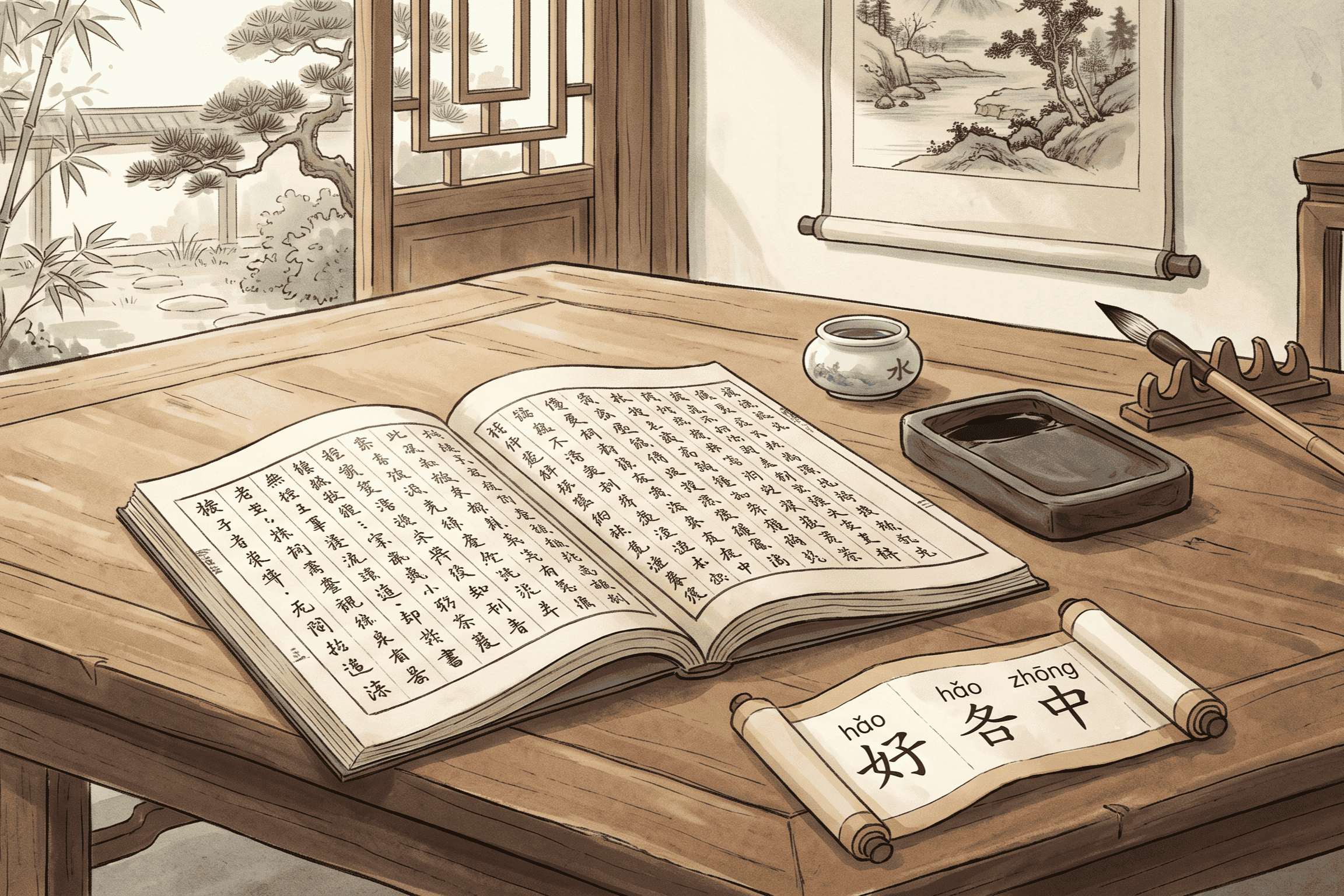
For more details, you can check out học tiếng Trung online. When starting to learn Chinese, many new learners ask the same question: "Does Chinese have an alphabet?" The short answer is no. Unlike English or Vietnamese that rely on a set of letters to form words, Chinese is written in characters called Hanzi (汉字). Each character is a graphic symbol that represents a syllable and a meaning.
At first, looking at a Chinese text can feel overwhelming – you see a string of complex shapes, each with its own stroke order. However, there is a phonetic system called Pinyin (拼音) that uses Roman letters to transcribe the sounds of Hanzi and is widely used in teaching and typing.
In this post, we'll explore how Chinese writing really works, and give you a clear roadmap to get started. If you're unsure how to begin, joining a structured program can help a lot.
Hanzi: The actual writing system
Chinese is a morphosyllabic language, meaning each character stands for a syllable and often a morpheme (meaningful unit). For instance, "水" means water, "人" stands for person, and "吃" means to eat. Each Hanzi is made up of a specific set of strokes, which follow strict stroke order rules.
The history and formation of Chinese characters
Hanzi are among the oldest continuously used writing systems in the world, originating more than 3,000 years ago from [oracle bone script] (甲骨文). Today, there are two main forms: traditional characters (used in Taiwan, Hong Kong, and Macau) and simplified characters (used in mainland China and Singapore). For most learners, focusing on simplified Chinese is more practical.
Characters are formed by components called radicals (部首). Example: "休" (rest) shows a person (亻) leaning against a tree (木). Understanding radicals will help you comprehend and memorize thousands of characters with greater ease.
Pinyin: The romanization system that acts as an alphabet
Although there isn't an alphabet per se, Chinese does use Pinyin for transcribing sounds. This scheme was introduced in the 1950s and officially adopted in 1958. It is often mistaken for an alternative, but it's only an auxiliary helper, not a primary writing system.
How a Pinyin syllable breaks down
Each Pinyin syllable contains three elements:
- Initial (声母): the leading consonant(s), for example b, p, m, f, zh, ch, sh.
- Final (韵母): one or more vowels, for example a, o, e, i, u, ü, an, ang, e.g.
- Tone (声调): Chinese is tonal; there are four main tones and one light tone.
For instance, "mā" (mother) uses the first high‑level tone, while "mǎ" (horse) uses a falling‑rising third tone.
Why Pinyin is compared to an alphabet
Because Pinyin uses letters from the Latin script, it's natural to compare it to an alphabet. However, pronunciation of some letters does not match English or Vietnamese. For example, 'q' sounds like the first sound of the English word "cheat" but with the tongue placed differently.
Typical Pinyin letters & combinations
Pinyin includes 26 letters, yet it also has distinctive consonant clusters like "zh", "ch", "sh" and vowel endings like "ao", "ie", "iong". That’s why you can’t just substitute English reading rules.
Differences between Chinese characters and a Latin alphabet
What really matters for learners is to understand the core difference:
- Chinese characters (Hanzi) are logograms: each represents one syllable, which is connected to meaning, not just sounds.
- An alphabet represents sounds at the phoneme level; letters by themselves have no inherent meaning.
- Hanzi are used in writing Chinese; Pinyin is just a helper for pronunciation. On a daily basis, native Chinese people write characters, not Pinyin.
Does Pinyin replace Chinese characters?
No, never. Even though you could type Chinese on a computer by entering Pinyin, the outcome is still Chinese characters that you must choose from a list. Besides, Pinyin is also employed for proper nouns and dictionaries, aiding non‑native speakers.
How to start learning Chinese effectively
Native Vietnamese speakers already have a head start on tones, letting them adapt to Chinese pronunciation quickly. Still, the biggest hurdle is recognizing and writing thousands of characters. Here is what you can do:
A step‑by‑step plan for beginners
- Learn Pinyin thoroughly, including tones and special sounds that don't appear in Vietnamese.
- Practice basic strokes and the most common radicals.
- Build up core vocabulary, each time writing out the character alongside the pinyin to reinforce memory.
- Immerse through music, movies, and speaking practice.
Considering an online course
With busy weeks, having a solid schedule and feedback from a teacher is invaluable. Many structured courses blend video lessons with spaced repetition practice.
Conclusion
To sum up, Chinese doesn't use an alphabet in the conventional meaning of the word. It uses Hanzi, a character‑based system, along with an auxiliary romanized system called Pinyin. Understanding that distinction early will help you choose the right methods for learning listening, speaking, reading, and writing. Best of luck on you China language journey!
Frequently Asked Questions
Does Chinese have its own alphabet?
No. Chinese has character‑based writing, but Pinyin (romanization) is used to represent sounds for teaching, transliteration, and computer input.
Is learning Mandarin as hard as it sounds?
It has its difficulties, but the grammar is relatively simple and tones are manageable. The main effort goes into learning a few thousand characters.
Is Pinyin worth learning for a total beginner?
Absolutely. It’s important for learning pronunciation and recognizing when you hear new words, and it's the foundation of typing Chinese.