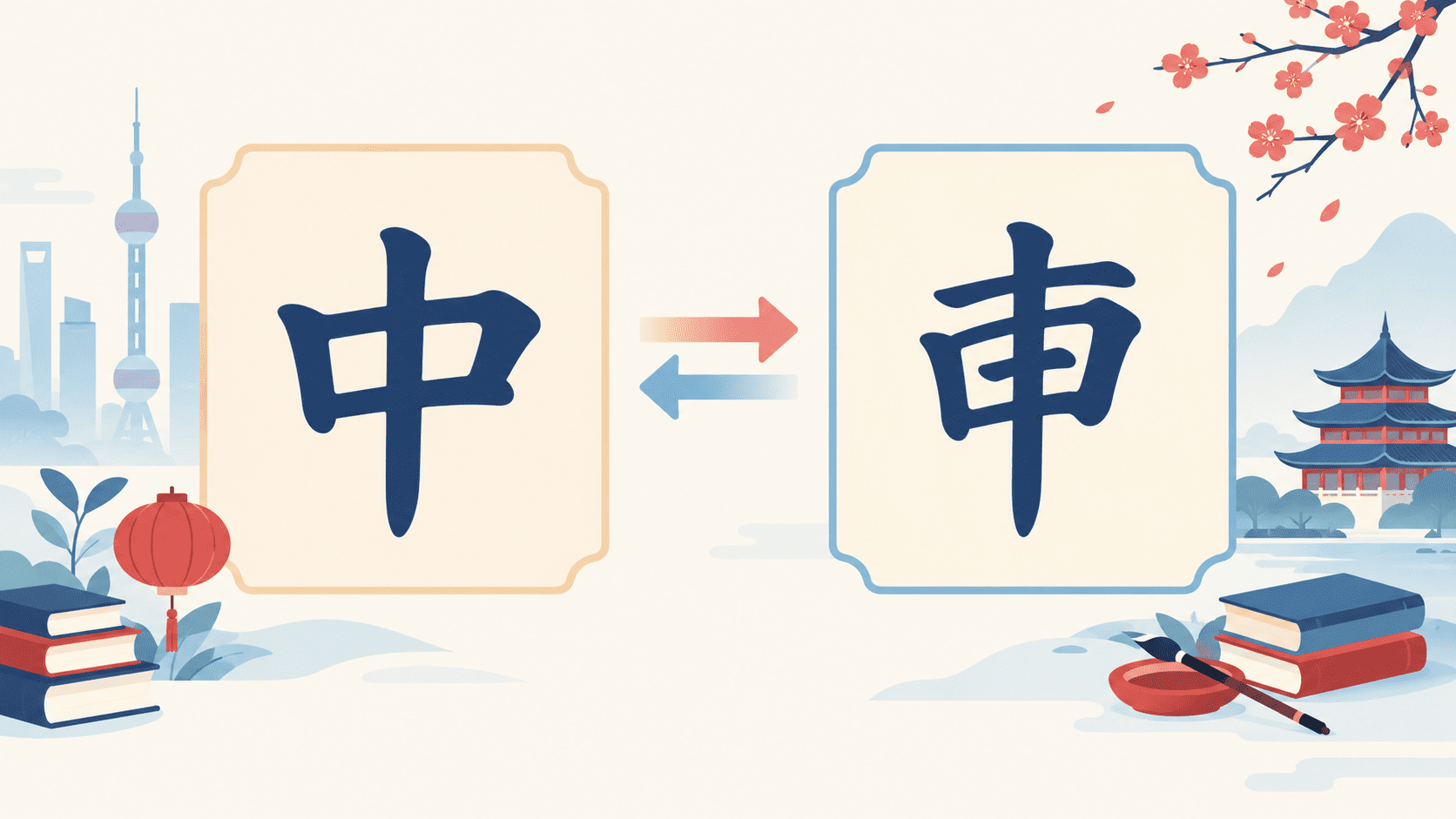
If you're just starting to learn Chinese, you've probably asked yourself: is Simplified Chinese easier than Traditional Chinese? It's a common dilemma, especially since both writing systems have their own advantages and challenges. This article breaks down the key factors so you can choose the path that fits your goals and lifestyle.
Understanding the two writing systems
Before comparing, let's look at the basics. Traditional Chinese characters are the original form, used for thousands of years and still official in Taiwan, Hong Kong, and Macau. Simplified Chinese, on the other hand, was introduced in mainland China during the 1950s to boost literacy. Singapore also adopts simplified characters.
The core difference is stroke count and structure. For instance, the character for "country" is 國 (11 strokes) in Traditional but 国 (8 strokes) in Simplified. Many simplified characters either reduce strokes or replace components with simpler forms, such as 語 → 语 (language) and 華 → 华 (flower). This is what makes one feel easier or harder for beginners.
Which is easier in terms of character structure?
If you only look at stroke counts, Simplified clearly has an edge. Fewer strokes mean quicker memorization and less writing effort – a relief for those aiming for basic communication. Most beginners find Simplified less intimidating because they avoid a steep learning curve.
However, Traditional Chinese isn't as scary as it seems. Some linguists argue that Traditional characters are more logical because they retain semantic components. For instance, the character for "love" (愛) includes the "heart" radical, reflecting the idea of love coming from the heart. In Simplified, it's 爱, where the heart radical is gone. If you're into culture and etymology, Traditional might actually be more engaging.
Reading challenges: the flip side of Simplified
One tricky aspect of Simplified is that several distinct Traditional characters are merged into one. For example, three Traditional characters for "fa" – 髮 (hair), 發 (to send) – both become 发 in Simplified. Readers must rely heavily on context, which can confuse beginners.
Traditional keeps these distinctions clear, making reading more precise. But for those planning to take HSK exams or study in China, Simplified is the required system since all official materials use it.
Your learning goal determines the difficulty
Ease depends not only on character shapes but also on your motivation. If you live in Vietnam and aim to access Chinese media or business resources, Simplified is practical due to its widespread use. Conversely, if you often work with Taiwanese or Hong Kong partners, or you're interested in classical texts, Traditional will serve you better.
In practice, readers familiar with Simplified can often pick up Traditional reading fairly quickly, while the opposite direction takes more effort.
Community and resources – where does the advantage lie?
Simplified Chinese enjoys an overwhelming advantage in the number of learners and available resources. Online courses, HSK textbooks, and dictionary apps are predominantly Simplified. This means you'll easily find study buddies and immediate help when you're stuck.
Traditional Chinese has a smaller but passionate community, especially from Taiwan, with excellent learning materials. Also, learning Traditional allows you to read Vietnamese Hán-Nôm documents, which were mostly written in this script.
Effective learning tips regardless of your choice
First, practice writing daily – use square-grid paper and write each character 5–10 times to internalize the shape and stroke order. Second, engage multiple senses: read aloud while writing, listen to audio, and repeat after it. Switching your phone or computer system to Chinese characters helps you get daily exposure.
Another useful tip: use apps that support pronunciation and character recognition, such as check Chinese pronunciation – a quick way to correct your sounds early before bad habits form. Don't hesitate to look up words and create flashcards with example sentences. Learning in context boosts long-term retention.
Conclusion
Returning to the question “which is easier, Simplified or Traditional?”, the answer lies within you. Simplified is easier for beginners thanks to fewer strokes and abundant materials. Traditional might feel simpler for those fond of classical culture or with a background in Hán-Việt. What's most important is to clarify your goals and stay consistent. I wish you an enjoyable and fruitful learning journey!
Frequently Asked Questions
Do Simplified and Traditional share the same pronunciation system?
Yes, both use pinyin and tones identically. The only difference is in the character form, so learners can switch between the two without trouble in terms of phonetics.
Should I start with Simplified or Traditional?
If you're a complete beginner and want global usability, start with Simplified. Once you're solid, you can add Traditional to explore Taiwanese or Hong Kong materials at your leisure.
Does learning Traditional help in reading Hán-Nôm?
Absolutely. Traditional characters retain their original structure, as do most Vietnamese Hán-Nôm texts. Mastering Traditional will allow you to read classical documents with ease and view them in their authentic form.