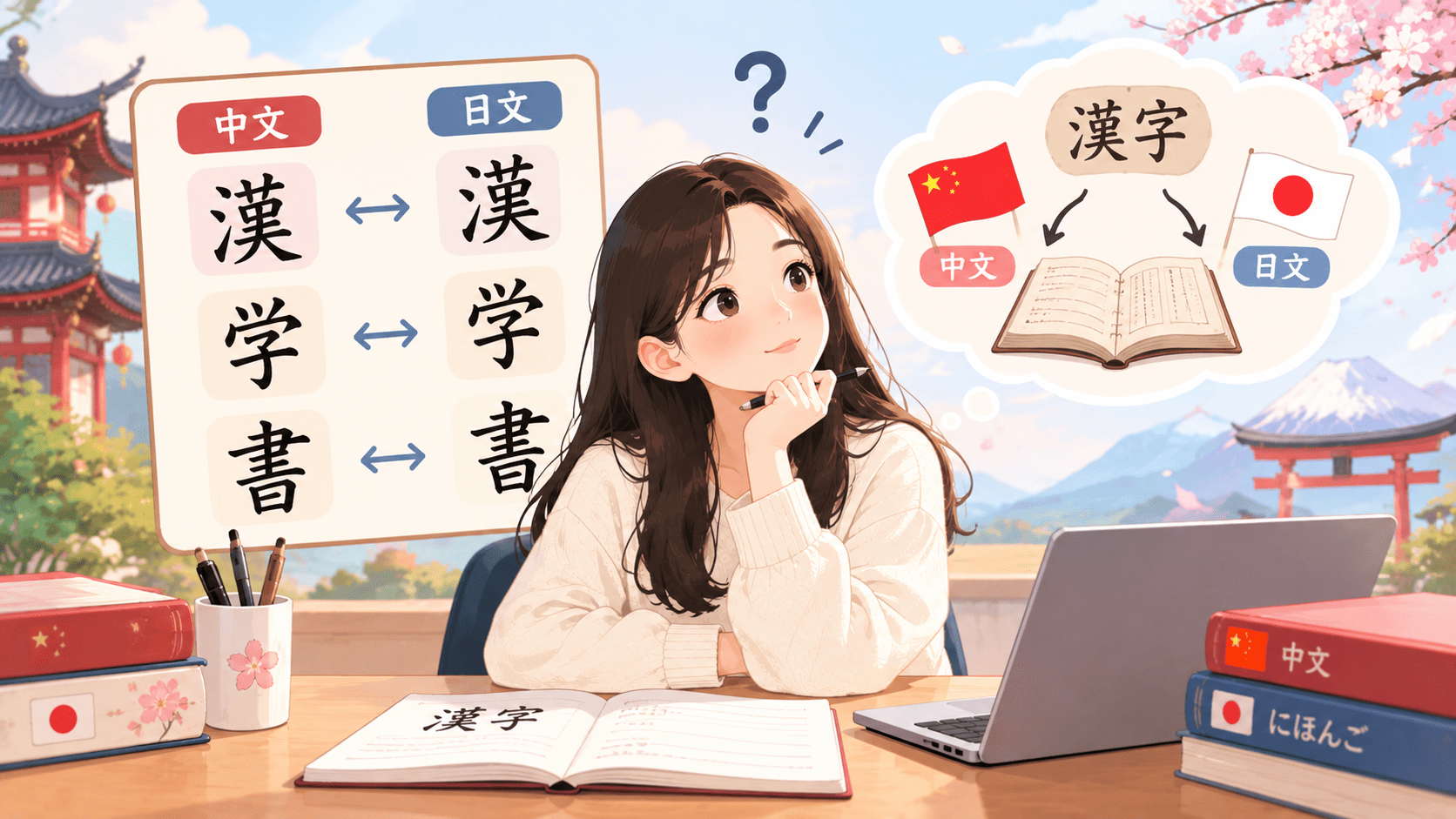
Show a Japanese newspaper to someone who has never studied either language, and they might guess it is Chinese. Characters like 日本, 学校, or 学生 look almost identical. That first impression is not wrong — it is just incomplete. Around 1,500 years ago, Japan had no writing system of its own. Chinese characters arrived through trade routes and Buddhist texts, and over centuries the Japanese reshaped them into something distinctly theirs. Understanding this shared history makes learning Mandarin easier, especially if you already know some Japanese.
When Chinese characters reached Japan
Between the 4th and 5th centuries, Japanese scholars and monks began importing Chinese books. At first they read them aloud in the original Chinese, but the two languages had very different grammar, so this was exhausting. By the 7th and 8th centuries, they started using Chinese characters phonetically to write Japanese sounds — a system called man'yōgana. That became the seed of modern kana.
One fascinating detail: many characters kept older Chinese meanings, so their sense can drift from modern Mandarin. The character 娘 means daughter in Japanese, but mother in modern Chinese. Details like this make Hanzi study far less dry than people expect.
Kanji is not a perfect copy of Hanzi
The Japanese did not copy everything exactly. Some strokes were simplified, others were written differently. The character 学 has 8 strokes in both simplified Chinese and Japanese, but the radical shape varies. 海 looks almost the same, yet 買 or 絵 differ by a few strokes. Even with a shared Hanzi root, you cannot read Japanese kanji as if it were Mandarin.
How kana was born from Chinese characters
The Japanese needed a way to write their own sounds, so they borrowed certain Chinese characters as phonetic symbols. Hiragana grew out of cursive handwriting popular with court women in the Heian period, while katakana came from monks abbreviating strokes in Buddhist annotations. Some clear examples:
- 安 became あ (a).
- 以 became い (i).
- 加 became か (ka).
This is why beginners often describe kana as "Chinese characters gone weird." In reality, every kana traces back to a specific Chinese character that was abstracted over hundreds of years.
Why Japanese still mixes kanji with kana
Japanese has no spaces, so a sentence written only in kana becomes hard to scan. Kanji works like visual anchors that help the eye parse meaning quickly. In a single sentence, you often see kanji for content words, hiragana for grammar, and katakana for loanwords. Take 私はベトナムで中国語を勉強します (I study Chinese in Vietnam). The kanji carry the meaning, while は, で, を, and します handle grammar.
Key differences between Japanese and Chinese writing
Despite the visual overlap, three differences stand out:
- Number of characters: modern Chinese uses more than 3,000 common characters, while Japan officially designates 2,136 Jōyō kanji for daily use.
- Reading systems: each Japanese kanji can have an on'yomi (Sino-Japanese) and a kun'yomi (native) reading, sometimes several of each. Chinese characters usually have just one standard pronunciation.
- Grammar: Japanese follows SOV order, Chinese follows SVO. The same sentence rearranges completely.
Interestingly, Japan led some simplification of characters before mainland China did, and Chinese simplified script later borrowed a few ideas. This back-and-forth explains why the two scripts feel so connected yet distinct.
Quick tips to tell them apart
When a character puzzles you, try these:
- Look for kana nearby. If you spot の, は, or を, you are reading Japanese.
- Check the radical shape. The simplified Chinese 讠 radical looks different from the full 言 form common in kanji.
- Compare meanings of familiar pairs. 手紙 means a letter in Japanese, but toilet paper in Chinese — worth remembering.
If you want a structured way to build vocabulary while mastering characters, following a clear study path helps a lot. Some learners explore a specialized Chinese course to match their field or career goals.
Why this matters for your Mandarin learning
Knowing the history behind shared characters gives you real advantages:
- Faster recognition through radical and component patterns.
- Better guesses at meaning when you encounter unfamiliar Sino-Japanese words.
- Fewer mistakes when reading bilingual documents in fields like engineering, medicine, or trade.
Many learners who study Chinese after Japanese find character memorization surprisingly easy. The reverse is also true — Chinese learners who later pick up Japanese feel less lost in front of a wall of kanji. It is a genuine transition advantage between two languages that share a Hanzi heritage.
Final thoughts
Japanese and Chinese look alike because they both grew from the same Hanzi root, but Japan spent over a thousand years shaping those characters into its own system. Kanji, hiragana, and katakana all trace back to Chinese origins yet function as a fully independent script today. Understanding that history gives you more confidence as a Mandarin learner and a deeper appreciation for how languages borrow, adapt, and evolve. Learning a language is always a bit like learning a history book, and this is one of the clearest examples you will find.
Frequently Asked Questions
Did Japanese characters come entirely from Chinese?
Not entirely. Kanji came from Chinese characters, but hiragana and katakana were created by the Japanese based on Chinese forms. Japan also invented some characters of its own, called kokuji, such as 働, which means to work.
Can Chinese speakers read Japanese?
Only partially. They may guess meanings from shared kanji, but grammar, kana, and vocabulary differences prevent full comprehension of Japanese text without dedicated study.
Does knowing Chinese make Japanese easier to learn?
Yes, especially for character memory and Sino-vocabulary. You will still need to study Japanese grammar and pronunciation separately, since the sound systems and word order differ.